0 x item(s)
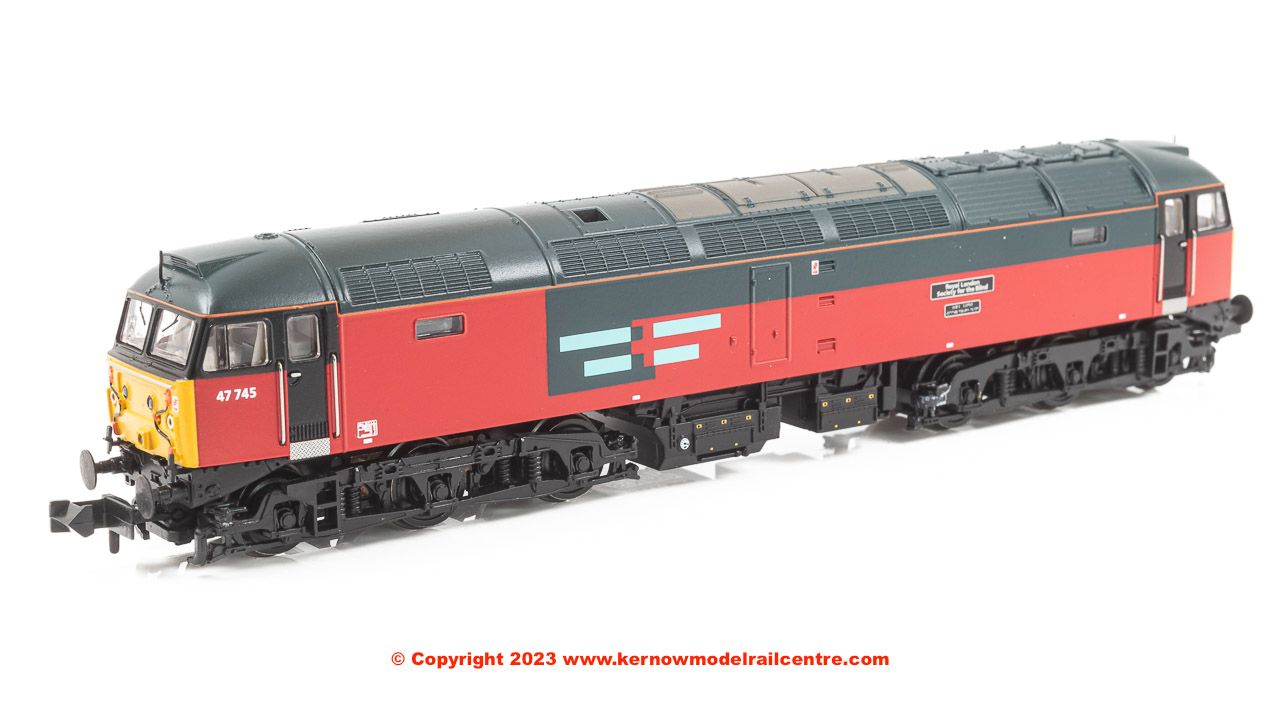
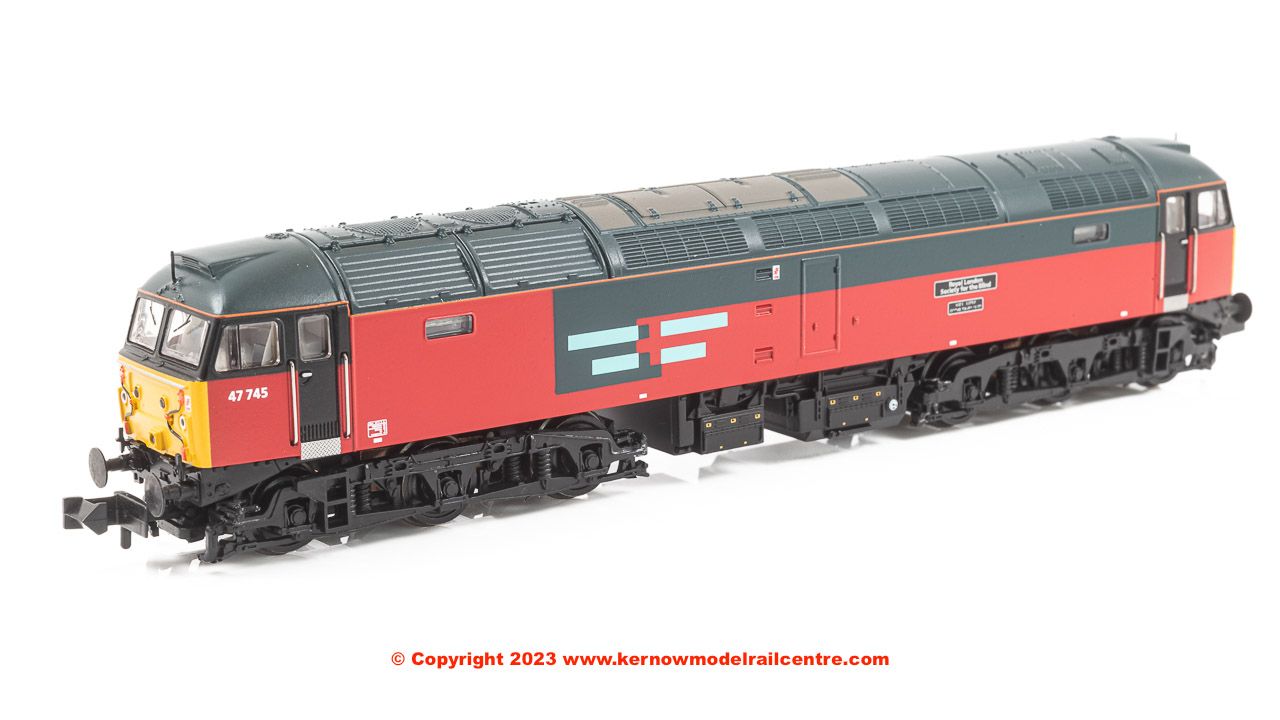
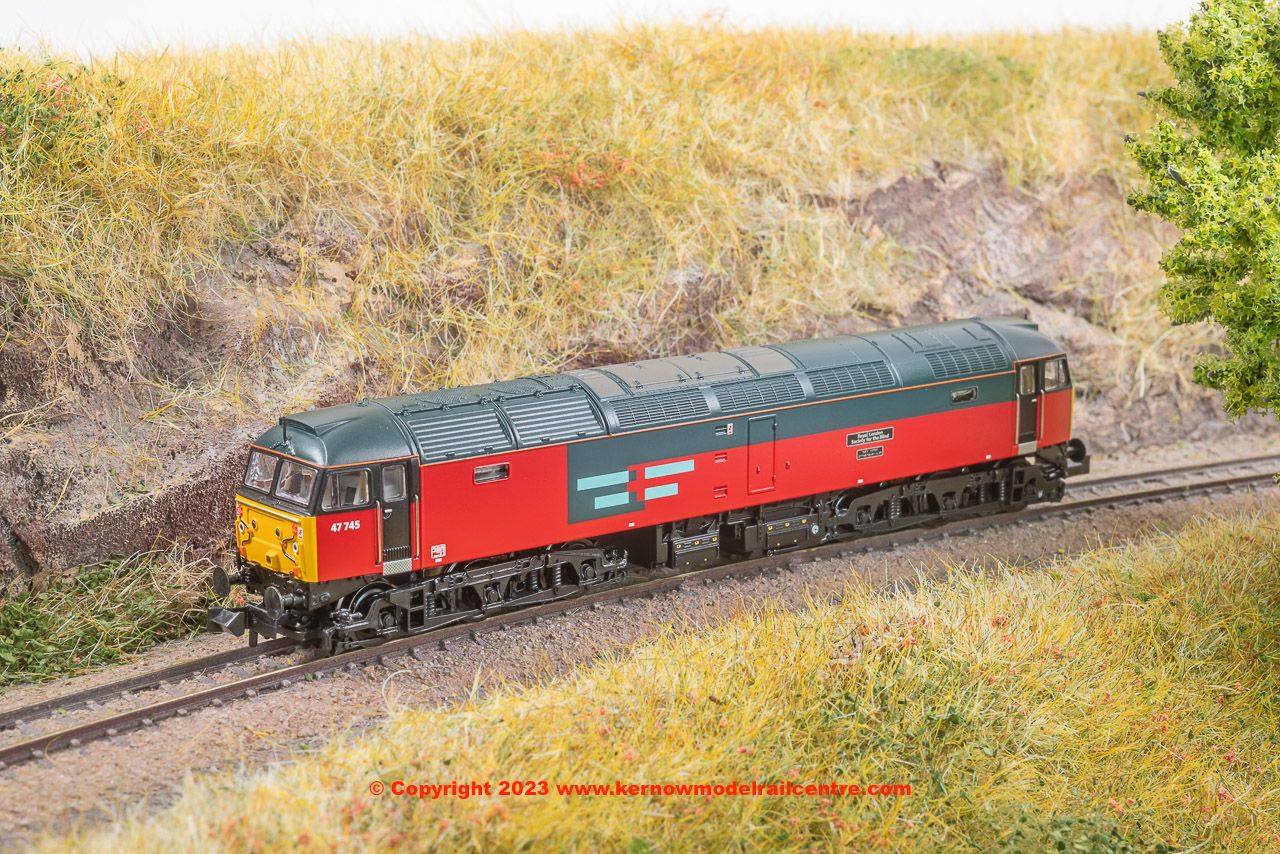
Click an image to enlarge.
|
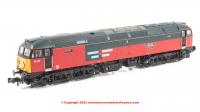
372-262SF Graham Farish Class 47/7 47745
The popular BR Class 47 Diesel Locomotive returns to the Graham Farish range with models of the ‘Crewe-Cut’ locomotives available for the first time thanks to the development of new tooling that further expands the range of Class 47s that can be modelled in N scale. Many Class 47s had the cowling around their bufferbeams removed in later life, changing the appearance of the lower front end and with this work usually being undertaken at Crewe Works, the resultant locomotives were commonly termed ‘Crewe-Cut’ machines. No. 47745 is one such machine, originally built as D1967, in 1983 it was fitted with Electric Train Heating (ETH) and became 47603 and later still was renumbered to 47745 in 1994 following the fitting of extended range fuel tanks and cab-front jumper cables when allocated to Rail Express Systems. Named ‘Royal London Society for the Blind’ in 1994, complete with a set of nameplates in Braille, the locomotive retained its Rail Express Systems livery until it was cut up in 2004.
Further developments to the Graham Farish Class 47 come in the form of technical advancements, with an upgraded specification which now boasts a Next18 DCC decoder interface, pre-fitted speaker, cab lighting (when used on DCC) and independent control of the directional lights at each end. With the Next18 interface and pre-fitted speaker, SOUND FITTED models can now be offered for the first time.
- Graham Farish N Scale
- Era 9
- Pristine Rail Express Systems livery
- Running No. 47745
- Named ‘Royal London Society for the Blind’
- SOUND FITTED – Fitted with a ESU Loksound V5DCC Sound Decoder – See below for the function list
- Length 130mm
DETAIL VARIATIONS SPECIFIC TO THIS MODEL
- Plated Headcode Panels with Sealed Beam Marker Lights at No. 1 End
- Cut-Cab Locomotive
- TDM Jumper Cables
- Single Arm Windscreen Wipers
- High Intensity Headlight
- Round Buffers
- Checker Plate Kickplate below Cab Door
- Partially Plated Cab Roof Vents
- Serck Radiator Grilles
- Smooth Exhaust Panels
- Plated Roof Boiler Port
- Water Tanks Removed
- Later Extended Range Fuel Tanks
- NRN Aerials
- Plated Bogie-mounted Cab Steps
GRAHAM FARISH CLASS 47 SPECIFICATION
MECHANISM:
- Coreless, twin shaft motor with two flywheels providing drive to both bogies
- All axle drive
- Electrical pickup from eight wheels
- Diecast metal chassis block
- Gearing arranged for prototypical running speeds and haulage capabilities
- 9mm (N gauge) wheels to NEM310 standards with authentic profile and detailing
- Bogie-mounted coupling pockets to NEM355 standards at each end
- Designed to operate on curves of second radius (263.5mm) or greater
DETAILING:
- Bogies constructed from multiple components featuring full relief detail
- Separately applied detail parts, including lamp irons, cab handrails and roof aerial (where applicable)
- Separately fitted battery box/water/fuel tank assembly
- Cab Interior Detailing
- Each model supplied with a full set of model-specific bufferbeam pipework and accessory parts
LIGHTING:
- Directional lighting, switchable on/off at either end on DCC or Analogue control
- Cab lighting, switchable on/off (when used on DCC only)
- Authentic light colours and temperatures selected for each model based on era and application
DCC:
- Next18 DCC decoder interface
SOUND:
- Speaker installed in all models for optimum sound reproduction
- ESU Loksound V5DCC Sound Decoder fitted to SOUND FITTED versions
- Sound files produced specifically for the Graham Farish Class 47 using recordings from real locomotives
- SOUND FITTED models operate on DCC and Analogue control as supplied
LIVERY APPLICATION:
- Authentic liveries applied to all models
- Multiple paint applications employed on each model using BR/TOC specification colours
- Logos, numerals and text added as appropriate using multi-stage tampo printing using authentic typefaces, logos and colours
SOUNDS
- F0 - Directional Lights - On/Off (plus Light Switch Sound)
- F1 - On - Warm Engine Start / On, Off - Failed Engine Start / On, Off, On - Cold Engine Start
- F2 - Brake
- F3* - Horn (Playable)
- F4* - Two-Tone Horn
- F5 - Heavy Load
- F6 - Coasting (Manual notch Down if F22 On)
- F7 - Maximum Revs (Manual notch Up if F22 On)
- F8** - On - Coupling Up / Off - Uncoupling
- F9 - Flange Squeal (Speed Related)
- F10 - Fan Noise
- F11 - Air Dump
- F12 - On - Guard’s Whistle / Off - Driver’s Response Horn
- F13 - Cab Lights On/Off No. 1 (plus Light Switch Sound)
- F14 - Cab Lights On/Off No. 2 (plus Light Switch Sound)
- F15 - Auto Uncouple Cycle
- F16 - AWS Horn
- F17 - AWS Bell
- F18 - On - Sound Fades Out / Off - Sound Fades In
- F19 - Mute (Latch) / Volume Cycles 6 Levels (Trigger)
- F20 - No. 1 End (Fan) Directional Lights Off
- F21 - No. 2 End (non-Fan) Directional Lights Off
- F22 - Manual Notching Logic On/Off (control with F6 & F7)
- F23 - Spirax Valve
- F24 - Station Announcement
- F25 - On - Driver’s Door Open / Off - Driver’ Door Shut
*Alternative Horn sounds and behaviour can be selected via CV changes
** Alternative coupling sounds can be selected via CV changes
Analogue Users: Please note that any automated drive sounds will be played when this model is used on analogue control (DC) straight from the box!
CLASS 47 HISTORY
Towards the end of the 1950s, British Railways began planning a new fleet of diesel locomotives and after investigating several prototypes, BR decided to place an order with Brush Engineering for 20 locomotives during February 1961. The resulting design became the iconic Brush Type 4 Diesel locomotive, a practical, versatile design with a very distinctive cab. Powered with a Sulzer engine and initially rated at 2,750hp, the locomotive could achieve a top speed of 75mph with a tractive effort of 55,000lb. Building commenced in January 1962 and the first locomotive No. D1500 appeared in late September of the same year with test runs on the London Midland Region and Western Region. The design was a success and BR went on to order a total of 512 with continuous production through to early 1967, forming the largest single class of main-line diesel locomotives in the UK.
During this time and subsequent years, several variations appeared with an increase in speed and tractive effort to 95mph and 62,000lb respectively. Originally fitted with four character train reporting head-codes, these changed to marker lights, with the addition of high intensity lights and roof aerials in the late 1980s. Other variations involved the fitting of different types of steam heating boiler for early BR coaching stock, later replaced with electric train heating for use with modern rolling stock. The numbering system started with four figures but changed to five with the introduction of the TOPS coding system which saw the locomotives classified as Class 47 Diesels with variations such as 47/0, 47/2, 47/3, 47/4 and 47/7. By the end of the 1990s, half of the Class 47 fleet had been withdrawn or scrapped, 33 have been converted into Class 57 locomotives and several have been preserved, including the original No. D1500, now numbered 47401.
Related Products
-
Academy Models
-

Accurascale
-
AFV Club
-
AIP by Bachmann
-
Airfix
-

Arnold
-
ATD Models
-
Auhagen
-
Bachmann
-
Bachmann Narrow Gauge
-
Bachmann USA
-
Barrie Stevenson
-

Bassett-Lowke
-
Berko
-

Busch
-
Cambrian
-

Clark Railworks
-

Corgi
-
Cornerstone
-
Dapol
-
Deluxe Materials
-
Dundas
-
Easy Model
-

Eckon
-
EFE Rail
-
EFE Road
-
Emhar
-

ESU
-
Exclusive First Editions
-
Faller
-

Fleischmann
-
Gaugemaster
-

Gecko Models
-

Golden Valley Hobbies
-
Graham Farish
-

Greenlight Collectibles
-

Heljan
-
HK Models
-
Hornby
-
Hornby International
-

Hornby TT:120
-

Humbrol
-

I Love Kit
-

Jouef
-
K&S Metals
-
Kadee
-
Kato
-
Kernow Models
-
Kestrel
-

Kibri
-
Layout Concepts
-
Lenz Digital
-
LightCraft
-

Liliput
-
Lionheart Trains
-

Merit
-

Metcalfe
-

Middleton Press
-
Mirror Models
-
Miscellaneous
-

model scene
-
ModelMaker
-
Murphy Models
-

Noch
-

Oxford Diecast
-
Oxford Rail
-
Parkside by Peco
-

PECO
-

Plastruct
-
Platform 5
-
PM Model
-

Preiser
-
Proses
-
RailMatch
-
Rapido
-
Ratio
-
Revell
-

Revolution Trains
-

Rivarossi
-

Roco
-
Roden
-

Scale Model Scenery
-

Scalextric
-
Shawplan
-
Slaters
-

Smiths
-
Springside
-
Star Tec
-
Strathwood
-

Superquick
-

Takom
-
Taliesin
-
Tillig
-
Tiny Signs
-
Toyway
-
Tracksetta
-

Train-Tech
-
TrainSave
-
Trumpeter
-

Viessmann
-

Vollmer
-
Wills
-

Woodland Scenics
-
Xuron

Copyright © Kernow Model Rail Centre 2001 - 2026
Connect with us socially