0 x item(s)
Bachmann Branchlines announce LMS Standard 20 Ton Brake Van in 00 Gauge
Contributed by:
14 Mar 2025 00:00am
Bachmann Branchlines have today, ahead of the London Festival of Railway Modelling have announced LMS Standard 20 Ton Brake Van in 00 Gauge.
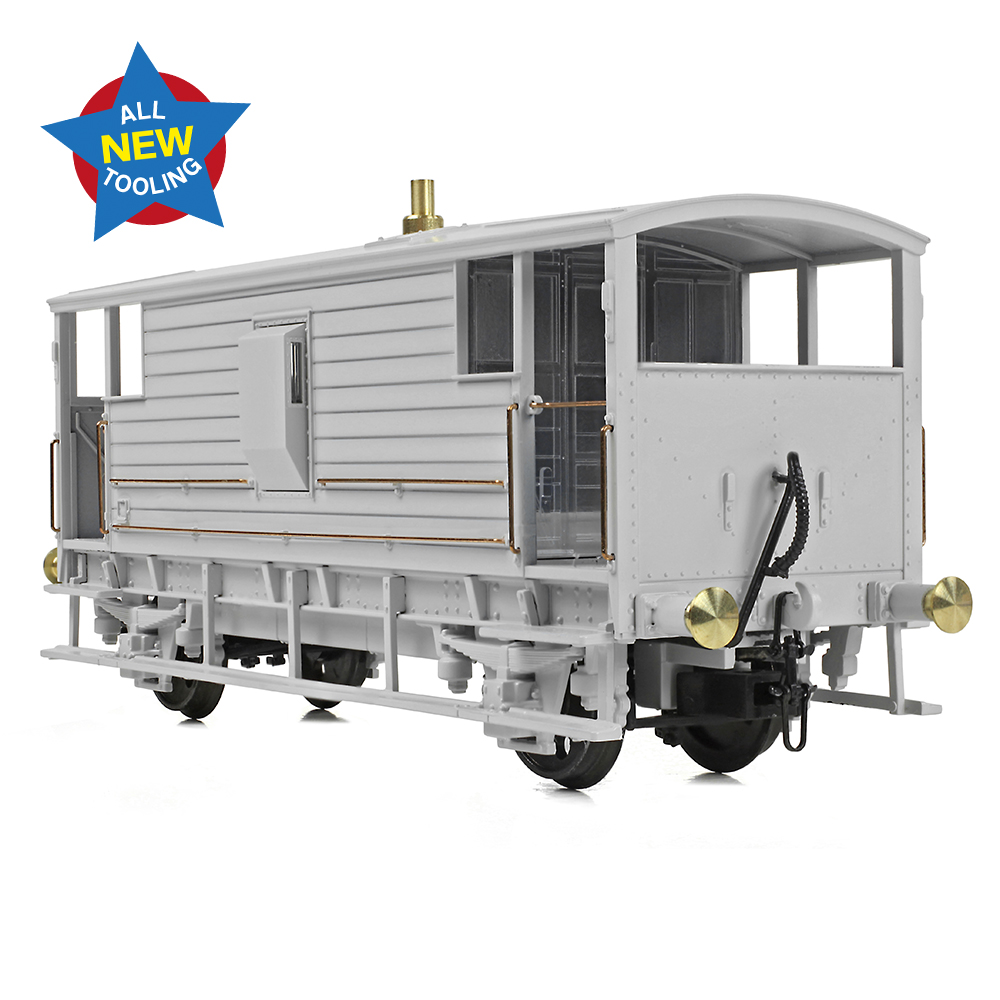
It was not until 1935 that the London, Midland & Scottish Railway (LMS) introduced the first of what ultimately became its standard brake van design – the 20 Ton, 16 foot wheelbase Brake Van. The first diagram to be assigned was Diagram D1919, and 670 such vehicles were constructed across five lots between 1935 and 1938. To reach the required weight of 20 tons, ballast weights were fitted beneath the chassis, notably these extended below the solebars making them a visible feature of the new vans. Whilst most were built unfitted (without any vacuum brakes), some, including the first 80, were built with through vacuum pipes.
Deviations from the original design occurred when deeper duckets were fitted to afford the guard a better view, increasing the width of the van by 6 inches and so a new diagram No. D2036 was issued in 1939 to record this change – 522 vans of this type would be built between 1940 and 1941. Whilst both types featured steel panelled ends, the new diagram marked a change from the heavily rivetted panels in ‘V’ pattern as seen on the D1919 vehicles, to a minimal number of rivets D2036 vans giving them a much tidier appearance.
A third diagram, No. D2068, was issued for vans built from 1942 until Nationalisation, the new design incorporating deeper ballast weights which now extended down to footboard level. Amongst the 10 lots built by the LMS to this diagram 75 were fitted with vacuum brakes.
The vans were used extensively by the LMS and later by the BR Midland Region and further afield, as brake vans were mandatory on all goods trains until the requirement was lifted in the late-1960s, yet still many services continued to operate with brake vans as late as the 1980s giving the LMS brake vans a long service life. One notable change during this time was the increased number of fitted goods services, for which many unfitted vans were through piped allowing them to run in fitted trains. Once the vans were finally made redundant, a second calling came for some in departmental use and today, more than fifty survive in preservation.
Five models make up the initial release, Delivery is scheduled for Q4 2025:
38-975 LMS 20T Brake Van LMS (L M S) Grey
38-976 LMS 20T Brake Van LMS (LMS) Grey
38-977 LMS 20T Brake Van BR Bauxite (Early)
38-978 LMS 20T Brake Van BR Bauxite (Late)
38-979 LMS 20T Brake Van BR Engineers Grey & Yellow
To pre-order click here
Thanks to an extensive tooling suite, models of all three diagrams can be produced covering their entire working lives and capturing the numerous differences seen on the real vehicles including:
Vans fitted with vacuum brakes, through vacuum pipes, or unfitted; Shallow or deep guard duckets,
Narrow or wide ducket beading, Flush or rivetted end panels, 18 inch or extended buffers, Shallow or deep ballast weights.
Alongside these individual features, every model boasts a sublime level of detail employing a high fidelity, injection moulded bodyshell which sports finely-moulded rain strips on the roof, precisely engraved panel lines, and thorough rivet detailing in all areas extending as far as the rears of the end panels and undersides of the ballast weights. Separate metal handrails are fitted throughout, including the balcony safety bars which can be fitted in the latched ‘closed’ position or left hanging ‘open’. Beneath the solebar, the W irons, axleboxes and springs are crisply moulded, supplemented by separate brake blocks and brake rigging. The exterior look is completed with the addition of separate footsteps and footboards, whilst metal buffers are employed along with blackened metal wheelsets and the standard tension lock couplings are carried in NEM coupling pockets.
The turned metal chimney on the roof hints at what’s inside and once the body is removed, the interior detailing is revealed and includes the stove with full height chimney, brake handwheel, ducket seats and tool chests. Flush glazing is fitted to the duckets and at either end of the cabin. Each model will be decorated authentically, both inside and out, using true to prototype colours, fonts and typefaces, setting a new standard for the LMS Standard Brake Van.
Subject to alteration.
Return to Page Top
-
Academy Models
-

Accurascale
-
AFV Club
-

AIP by Bachmann
-

Airfix
-

Arnold
-

ATD Models
-

Auhagen
-

Bachmann
-

Bachmann Narrow Gauge
-

Bachmann USA
-
Barrie Stevenson
-

Bassett-Lowke
-

Berko
-

Busch
-

Cambrian
-

Clark Railworks
-

Corgi
-

Cornerstone
-

Dapol
-

Deluxe Materials
-

Dundas
-

Easy Model
-

Eckon
-

EFE Rail
-

EFE Road
-

Emhar
-

ESU
-

Exclusive First Editions
-

Faller
-

Fleischmann
-
Gaugemaster
-

Gecko Models
-

Golden Valley Hobbies
-

Graham Farish
-

Greenlight Collectibles
-

Heljan
-

HK Models
-

Hornby
-

Hornby International
-

Hornby TT:120
-

Humbrol
-

I Love Kit
-

Jouef
-

K&S Metals
-

Kadee
-

Kato
-
Kernow Models
-
Kestrel
-

Kibri
-

Layout Concepts
-

Lenz Digital
-
LightCraft
-

Liliput
-

Lionheart Trains
-

Merit
-

Metcalfe
-

Middleton Press
-
Miscellaneous
-

model scene
-

ModelMaker
-
Murphy Models
-

Noch
-

Oxford Diecast
-
Oxford Rail
-
Parkside by Peco
-

PECO
-

Plastruct
-

Platform 5
-

PM Model
-

Preiser
-

Proses
-
RailMatch
-
Rapido
-
Ratio
-

Revolution Trains
-

Rivarossi
-

Roco
-
Roden
-

Scale Model Scenery
-

Scalextric
-
Shawplan
-

Slaters
-

Smiths
-
Springside
-
Star Tec
-

Superquick
-

Takom
-
Taliesin
-

Tillig
-
Tiny Signs
-

Toyway
-
Tracksetta
-

Train-Tech
-

TrainSave
-

Trumpeter
-

Viessmann
-

Vollmer
-

Wills
-

Woodland Scenics
-

Xuron

Copyright © Kernow Model Rail Centre 2001 - 2026
Connect with us socially